

Planning a furniture move in Jeddah during Ramadan? Jeddah Dabab Express works day and night all month, with the best slots after iftar and after taraweeh — plus a table of the best hours, a moving-day plan and a final price before loading.
Moving furniture in Ramadan in Jeddah follows a rhythm unlike the rest of the year, and knowing that rhythm saves you hours of traffic and fatigue. The city sleeps through part of the day and wakes at night; a street that is usually packed at noon is quiet, and a road that is calm at ten at night normally becomes one of the busiest. At Jeddah Dabab Express we work all month, day and night, and from the Ramadan moves we handle every year we know which hours work and which are wasted. To book or ask, call or WhatsApp 0544866865 at any time.
Many people who call us in Ramadan want to finish before Eid — because the new home is ready, because the family will gather there, or because the handover date of the old home cannot move. This guide is for them: how Jeddah’s movement changes during the month, which times suit loading, and how to split the work between the fasting day and the iftar night so you do not reach Eid exhausted with half your home still in boxes.
- A full move works best after iftar and after taraweeh; daytime is for calm packing and sorting.
- Avoid the hours just before maghrib — roads are packed and there is not enough time.
- The last ten nights and the days before Eid are the busiest, so book well ahead.
- Think of neighbours sleeping after suhoor in apartment buildings, and move large pieces early in the night.
- The same price list all year: a piece within the district from SAR 65, a room between neighbouring districts from SAR 110.
How does Jeddah move in Ramadan?
On ordinary days Jeddah is busy in the morning with work and in the afternoon with the return home, then eases late at night. In Ramadan that schedule flips. Mornings are quieter because work starts later and many people leave home late. Traffic builds through the afternoon and peaks in the hour before maghrib, as everyone rushes home or to iftar with family. In the minutes after the call to prayer the streets suddenly empty, then life returns after isha and taraweeh.
After taraweeh the markets and shops open and commercial streets stay full until late, especially in districts with big markets and in Al Balad, which is decorated for Ramadan and draws visitors. Inner residential districts remain reasonable, though, and parking outside buildings is easier because many residents are out. After midnight almost everything calms down until close to suhoor. Understanding this rhythm is half the planning: do not load at the hour the whole district goes out, and do not cross the city just before iftar.
Ramadan timing table
This table sums up what we see on Ramadan moves inside Jeddah. It varies a little between districts, but works as a general guide to choosing your slot:
| Period | Rating | Why |
|---|---|---|
| After fajr until mid-morning | Excellent for short moves | Empty roads, milder air, the crew still fresh |
| Mid-morning to noon | Good | Light traffic, but physical effort gets harder for a fasting crew as the day goes on |
| Afternoon | Avoid for large moves | Peak fatigue, and heat if Ramadan falls in summer |
| The hour before maghrib | Avoid | The worst traffic of the day and not enough time to finish |
| After iftar until isha | Good for setting up | A short window, fine for the dabab to arrive and start wrapping |
| After taraweeh until midnight | Best overall | Full energy, cooler air and parking in residential districts |
| After midnight until suhoor | Excellent for the road | The quietest roads, with care for sleeping neighbours |
If Ramadan falls in winter the day is easier and mid-morning slots can be widened.
Fasting crews: why heavy work goes after iftar
We say this plainly because it matters to you: carrying a wardrobe down the stairs at three in the afternoon while fasting is not the same as carrying it at ten at night after iftar and a rest. A tired mover carries more slowly, misjudges turns and needs more breaks, which affects both time and the safety of your pieces. So we schedule heavy and long moves — especially upper floors without a lift — after iftar, and keep daytime for one or two pieces or a short run within the district.
If your move is from a high floor without a lift, this advice counts double; see moving without a lift in Jeddah. We never refuse a daytime slot if it is the only one you can manage — we tell you what suits best and leave the choice to you.
Planning a Ramadan moving day
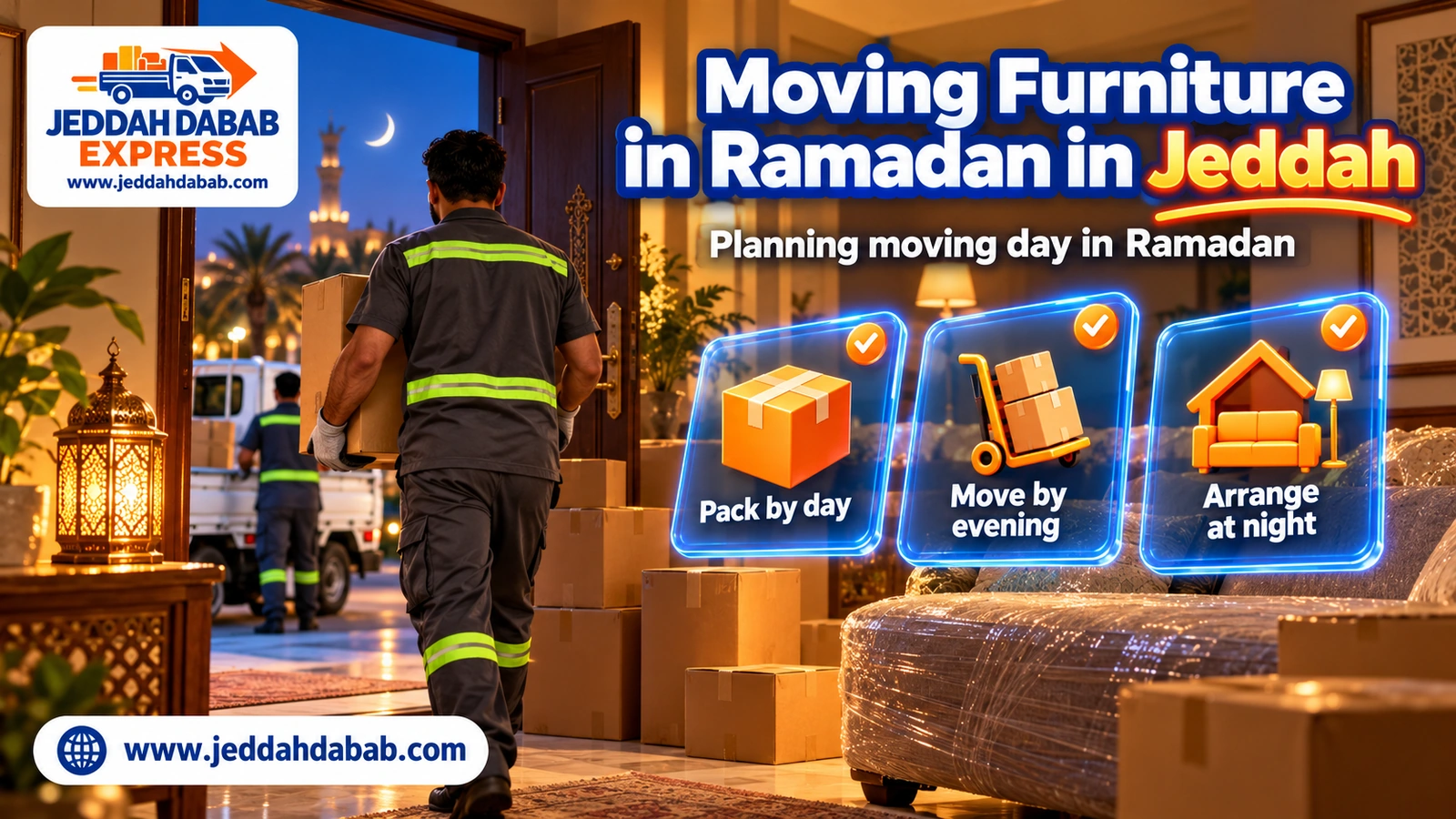
The most successful Ramadan moves we have seen were split into three clear stages, each at the right time of day. That way the homeowner never carries the strain of fasting, packing and moving in the same few hours.
Daytime: calm packing and sorting
Use the morning and noon for light work that needs little effort: sorting clothes, boxing books and dishes, writing the room name on every carton, emptying drawers. Start with the least-used rooms, then the majlis, and leave the kitchen until last because you will need it to prepare iftar. Materials and how to wrap each piece are in packing furniture before moving in Jeddah.
After iftar: dismantling, loading and the drive
The dabab arrives after iftar or after taraweeh as agreed. We start by dismantling wardrobes and beds and wrapping large pieces, then load the heaviest first. It helps if you have prayed, eaten and rested a little, because you need to be there to decide what goes and what stays. Dismantling, assembly and numbering parts are explained in furniture dismantling and assembly in Jeddah.
Late night: settling into the new home
On arrival we place each piece in its room and assemble the beds first, because you will need to sleep after suhoor. Then the kitchen basics only: the fridge in place and suhoor dishes in one open carton. The rest can wait for the next night — do not try to finish everything at once.
If your aim is to move a whole flat in one day, the same plan applies with the stages compressed; see moving a flat in one day in Jeddah.
Before Ramadan, during it, or after Eid?
If your date is flexible, this is the most important question. Each timing has a benefit and a drawback, and the choice depends on what presses on you: the handover date, the family gathering at Eid, or how much fatigue you can take.
| Timing | Benefit | Drawback |
|---|---|---|
| Two weeks before Ramadan | Full energy and flexible daytime slots | Many people think the same way, so demand rises |
| First week of Ramadan | Relatively lower demand | Your body is still adjusting to fasting |
| Mid-Ramadan | Usually the calmest part of the month | Comfortable working hours are mostly at night |
| Last ten nights | You reach Eid in your new home | Highest demand and traffic; roads to Makkah are packed |
| Just before Eid | Little to gain | Among the busiest days of the year; slots nearly full |
| A week after Eid | Calm and low demand | The handover date may not allow waiting |
If the move is tied to a handover date that will not shift, there is little choice, and early booking is all you can do. If it is flexible, mid-Ramadan or a week after Eid are the calmest options. What we see every year is people postponing to the last ten nights and then all calling on the same days.
When Ramadan falls in summer
Ramadan moves earlier by some days every year, so it sometimes falls in Jeddah’s mild winter and sometimes in its hot, humid summer. When fasting meets summer heat, night slots become a necessity rather than a preference, and early morning is the only reasonable alternative. Protecting furniture from sun and humidity is covered in moving furniture in Jeddah summer heat.
- Leather and lacquered furniture: suffers in direct sun on the open dabab bed, so we cover it with light blankets.
- Candles and thin plastics: can soften in the heat — do not leave them in the bed for long.
- Electronics: let them reach room temperature and dry off any condensation before switching on.
- Medicines and sensitive items: carry them in your air-conditioned car, not in the load.
- Water for the crew after iftar: night work in Jeddah’s humidity needs constant drinking.
Neighbours and buildings on Ramadan nights
Moving at night is easier for you and the crew, but it can disturb others. In apartment buildings many residents sleep straight after suhoor, and furniture knocking on the stairs or dragging across tiles at three in the morning carries through every flat. So we suggest moving large pieces and appliances early in the night after taraweeh and leaving light cartons for later. Tell the building guard and your immediate neighbours a day ahead; a kind word in advance prevents a complaint afterwards.

Watch the parking too: early in the night commercial streets fill with cars, while residential districts are better off. The dabab is small, enters lanes and stops near the entrance without needing much space, but a nearby spot still shortens the carry and speeds things up.
Moving to Makkah and nearby cities in Ramadan
The Jeddah–Makkah road in Ramadan is unlike the rest of the year: pilgrim traffic is heavy all month and peaks in the last ten nights. If you are moving to Makkah, book early; we pick a quieter time on the road with you and strap the load more tightly for the long run. The price is set by load and destination — see dabab from Jeddah to Makkah, and likewise dabab from Jeddah to Taif with advance booking.
Booking and moving steps in Ramadan
- Call early: give the from and to districts, floors and large pieces, your preferred date and a fallback.
- Choose the window: we agree on a slot after iftar or after taraweeh, or an early morning for short moves.
- Final price: given before the day once we know the pieces, distance and floor, and unchanged if the load is as described.
- Your daytime preparation: cartons sealed and labelled, drawers empty, the Ramadan box set aside.
- Arrival and dismantling: the dabab arrives on time and we dismantle and wrap large pieces first.
- Loading and the drive: heaviest low and near the front, straps on everything before we move.
- Unloading and assembly: beds first, then the fridge and basic kitchen, and you check the pieces with us before we leave.
What does a Ramadan move cost?
Our starting prices do not change in Ramadan. The final price depends on the pieces, distance and floor as at any time of year, and we give it before loading. Details on Jeddah dabab prices:
| Service | Price |
|---|---|
| A piece or ride within the district | from SAR 65 |
| A room between neighbouring districts | from SAR 110 |
| A north-to-south Jeddah move | from SAR 185 |
| Small / medium / large wanet | from SAR 140 · from SAR 230 · from SAR 320 |
| Split AC removed, moved and refitted | from SAR 230 |
| Furniture dismantling and assembly | Set by pieces — ask for an itemised quote |
| Moves to Makkah and Taif | Set by load and destination — ask for a trip quote |
What saves money in Ramadan is what saves it any time: preparation that shortens the crew’s time, the right vehicle for the load, and combining pieces into one trip. Cheapest dabab furniture moving in Jeddah explains the difference between an all-in price and one that grows on arrival.
Mistakes that repeat on Ramadan moves
- Leaving the booking to the last ten nights, then hunting for a slot on the same days as everyone else.
- Packing the whole kitchen by day and having nothing left to prepare iftar.
- Trying to pack, move and arrange a large flat in a single night.
- Carrying heavy pieces on the stairs late at night while neighbours sleep.
- Leaving medicines and documents in the cartons instead of with the homeowner.
Questions to ask before booking in Ramadan
- Do you work after taraweeh and after midnight?
- Does the price change in Ramadan or in the last ten nights?
- How long will dismantling and loading take, so I can plan suhoor?
- Do you protect the stairs and walls to avoid marks and noise for the neighbours?
- If the load is large, is it better as two dabab nights or one wanet night?
Coverage across Jeddah
In Ramadan we work in every Jeddah district as in the rest of the year: Obhur, Al Shati, Al Rawdah and Al Salamah in the north; Al Safa, Al Marwah, Al Faihaa and Al Naseem in the centre and east; Al Balad, Al Hindawiyah, Al Hamdaniyah and Al Khumrah in the south. The small dabab enters the lanes of older neighbourhoods that fill up on Ramadan nights and have no room for big trucks. Find your district on Jeddah districts.
Why Jeddah Dabab Express in Ramadan?
Direct answers on Ramadan moves
| Question | Answer |
|---|---|
| Best time to move? | After taraweeh until midnight. |
| Worst time? | The hour before maghrib. |
| Does the price rise? | No — the same price list, with the final price before loading. |
| When should I book before Eid? | Before the last ten nights if possible. |
| How do I split the work? | Pack by day, move by night, set up the basics the same night. |
For a full household move see Jeddah furniture moving dabab; for heavy appliances like the fridge and washer, moving household appliances in Jeddah; and if you are moving an office or shop over the Eid break, office and shop relocation in Jeddah.
Frequently asked questions
Do you work during Ramadan?
Yes. We work throughout Ramadan, day and night, with calls and WhatsApp open around the clock. The busiest slots of the month are after iftar and after taraweeh.
What is the best time to move furniture in Ramadan in Jeddah?
The best time for a full move is after isha and taraweeh until midnight, then after midnight if it will not disturb neighbours. Early morning after fajr suits short moves.
Do moving prices go up in Ramadan?
Our starting prices do not change in Ramadan: a piece within the district from SAR 65 and a room between neighbouring districts from SAR 110, with the final price given before loading.
When should I book a move before Eid?
As early as you can, ideally before the last ten nights, because the final days of Ramadan and the run-up to Eid are among the busiest times of the year for bookings and roads.
Are the movers fasting, and does it affect the work?
We schedule heavy jobs after iftar, when the crew is at full strength, and keep daytime for light, short moves. That protects the quality of the carry and your furniture.
Can I move after midnight in Ramadan?
Yes — roads are quieter after midnight and parking is easier. But think of neighbours in apartment buildings, as many sleep after suhoor, and leave large pieces for earlier.
Which time should I avoid in Ramadan?
Avoid the hours just before iftar, when roads fill with people heading home and there is not enough time to finish, and avoid the afternoon heat if Ramadan falls in summer.
How do I move a whole flat in Ramadan without exhaustion?
Split the work: pack and sort calmly by day, move at night after iftar, and arrange the same night or the next. If the load is large, spread it over two nights.
Do you move to Makkah in Ramadan?
Yes, with advance booking, priced by load and destination. The Jeddah–Makkah road is busy in Ramadan, especially the last ten nights, so we pick a quieter time with you.
What should I keep out of the boxes on a Ramadan moving night?
Pack a small box for suhoor and the first iftar: dates, water, cups, a prayer mat, a Quran, chargers and medicines — and keep it with you, not in the dabab.